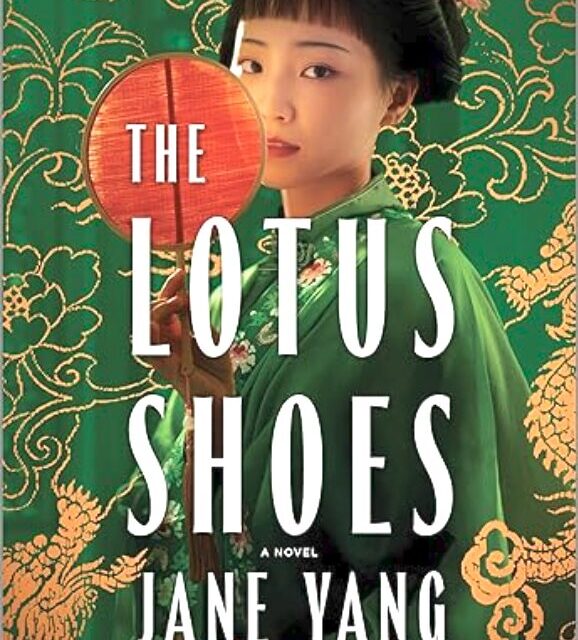


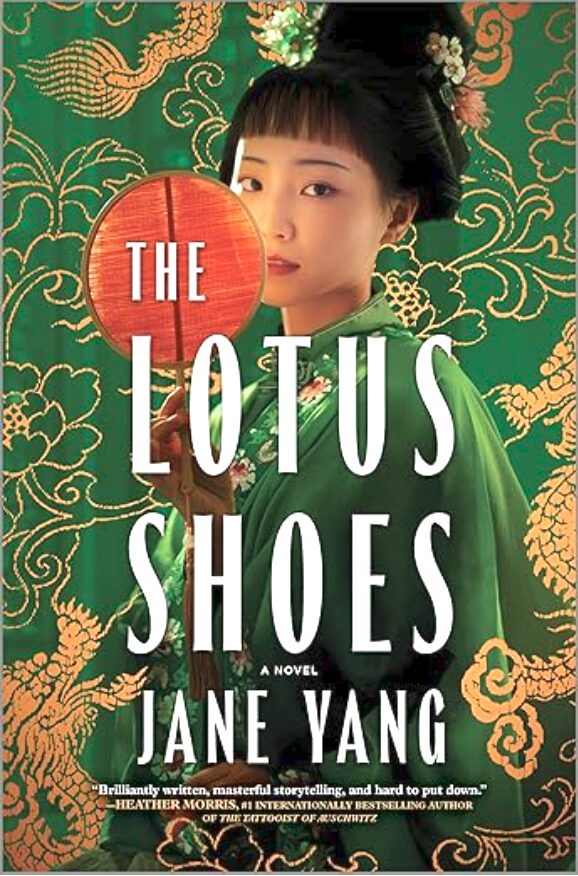

The Gulf Harbour Book Club met on October 6 to discuss Jane Yang’s The Lotus Shoes. There were 32 of us in attendance in person and via Zoom.
Linda Rosalanko did a fabulous job on presenting Jane’s bio.
Jane fell in love with historical fiction when she discovered Pride and Prejudice in eighth grade and has never looked back. Born in a Chinese enclave of Saigon, and raised in Australia, Jane grew up on a diet of ancestral stories and superstition. Despite establishing a scientific career, first as a pharmacist and later in clinical research, she is still sometimes torn between modern, rational thinking and the pull of old beliefs, like the supernatural. Jane’s family tales are an inspiration for her writing. She writes stories about women in pre-Communist China, exploring power and class struggles, and sometimes with a dash of suspense, spirits and hauntings. This is Jane’s debut novel.
In Vietnam, her parents owned a flourishing small business: life was comfortable. At 44, Dad had little incentive to start over in another country, but Mum wanted her children to grow up in a democracy. As always, Dad indulged her. With the Vietnamese dong being so low in relative value, Dad sold everything we owned to pay for our airfares to Australia. Once here, Dad labored the rest of his working years in a die-casting factory while Mum sewed garments for as little as 50 cents apiece.
Both of my grandmothers were storytellers. From my Maa Maa, my paternal grandmother, I learned about foot binding.
My maternal grandmother, Po Po, loathed the patriarchy and longed to take the sor hei vows and join a celibate sisterhood. This phenomenal feminist movement is central to the second half of The Lotus Shoes.
Since I was 15, I’ve been a huge fan of historical fiction. I still remember the day I found a tattered copy of Pride and Prejudice in my school library. I found it relatively easy to inhabit my characters’ worldview. Let’s take beauty and status as an example. The vast majority of women have always strived to adopt the beauty norms of their time. Tudor ladies whitened their faces with poisonous lead paint, while their Victorian counterparts practiced tight lacing. Today, Botox and fillers are all the rage. Bound feet are, of course, perhaps the most extreme form of body modification in the name of beauty, but Little Flower and Linjing’s struggles are familiar and relatable. Like us, they crave acceptance and admiration.
Jane has a husband and three children. She started The Lotus Shoes when she was pregnant with her first child, he is now 13! She has a wonderful husband who always encouraged her to write this book. Jane has now written another book due out in 2027. We will be in touch to invite her back.
The following review was written by Jane Yang for The Book Reporter. We could not have done a better job.
“In The Lotus Shoes, an engrossing novel of old China set in the late 1800s, Jane Yang recounts the sometimes-tragic lives of girls and women at a time when females were undervalued. Little Flower’s father died when she was six, and her mother was forced to sell her as a slave to a wealthy family so that her brother wouldn’t starve to death. She was to be a maidservant to Linjing, the daughter of the family, who was the same age as her.
At that time in China, upper-class women had their feet bound at an early age so that their feet would be tiny. Girls with big feet were considered peasants, low class and unable to marry anyone but another peasant. Having tiny feet was considered a sign of good taste, intelligence and a fine upbringing. So when Linjing’s father asks that her feet not be bound, it’s because he wants her to be betrothed to a boy whose father is looking for a girl with unbound feet. This man is an important politician, and he’s had business dealings with Westerners who thought feet-binding was primitive.
“[T]he novel as a whole is breathtakingly powerful. The images of old China and the cruel culture of abusing women are concepts that will remain on readers’ minds long after the book is back on the shelf.”
But no upper-class family would agree not to bind their daughter’s feet because of the insidiousness of the tradition. Linjing’s father convinces her mother, Lady Fong, to agree, but Linjing is devastated. This spoiled child is furious that Little Flower has bound feet and insists that her feet be unbound. Little Flower’s mother had drilled into her that under no circumstances should she quit binding her feet, and she instilled in her the importance of having bound feet in order to make a good marriage. Even as a slave, when she turned 18, Lady Fong had agreed to find Little Flower a husband.
Linjing gets her way, and Little Flower’s feet are unbound, leaving her not only with big feet, but with feet that are horribly deformed from two years of binding. She is also terribly jealous of Little Flower’s incredible talent for embroidery. Linjing is color blind, and while it’s no fault of hers, she’s chastised and ridiculed for her inability to create beautiful images with silk thread. Little Flower’s skills are unsurpassed, and in a culture that believes only those with “lotus” feet – tiny bound feet – have the delicate and superior capability of creating lovely embroidery, that makes her special.
The book is both touching and incredibly difficult to read as we witness, through Yang’s evocative, descriptive narrative, the deprivations and privations that Little Flower undergoes. The treatment of women as a whole is appalling, as is the complete lack of compassion and kindness we see in the matriarch of the Fong family, who rules with an iron fist. All live in fear of her. Her son’s first wife and his minor wives are forced to do her bidding in an effort to keep her from punishing them.
On a grander scale, we learn about the fragility of a woman’s existence in China at that time. Females had no rights, and even those from a good family would only gain power by becoming a first wife and then the mother of a son. If a woman could not produce a son, she could be divorced and left to die in the streets.
The Lotus Shoes focuses on the relationship between Linjing and Little Flower as their fates become entwined. Little Flower is determined to free herself from slavery, and Linjing wants to deny Little Flower her freedom. Both have strong personalities, but because of her status, Linjing has more power. The story is engrossing, and we come to care about Little Flower as she is dealt one blow after another. Her determination and intellect serve her well, but one girl cannot stand against an intransigent culture like that of China at that time.
Is the ending a bit too pat? Perhaps. But that’s a negligible criticism when the novel as a whole is breathtakingly powerful. The images of old China and the cruel culture of abusing women are concepts that will remain on readers’ minds long after the book is back on the shelf. I have been to China, and there is much beauty there, but I wish I had read more books like this one before my visit. It would have made me more aware of the horrors that women endured just 100 years ago.
The Gulf Harbour Book Club meets on the first Monday of each month in the Fitness Center. If you want to join the book club email [email protected]. Zoom is available for members if the author allows it. We had nine authors lined up for the 2025/26 season. We already had Kristen Harmel and now Jane Yang. We have the following authors on Zoom. November is Abi Dare’s The Girl with the Louding Voice and its sequel And So I Roar, December is Not Yours to Keep by Zelly Ruskin, January is Bernhardt Schlinke for The Granddaughter, March is Sandi Altner for Rupert’s Landing, April is Chris Torockio for The Soul Hunters and May is Stephanie Dray for A Founding Mother.