

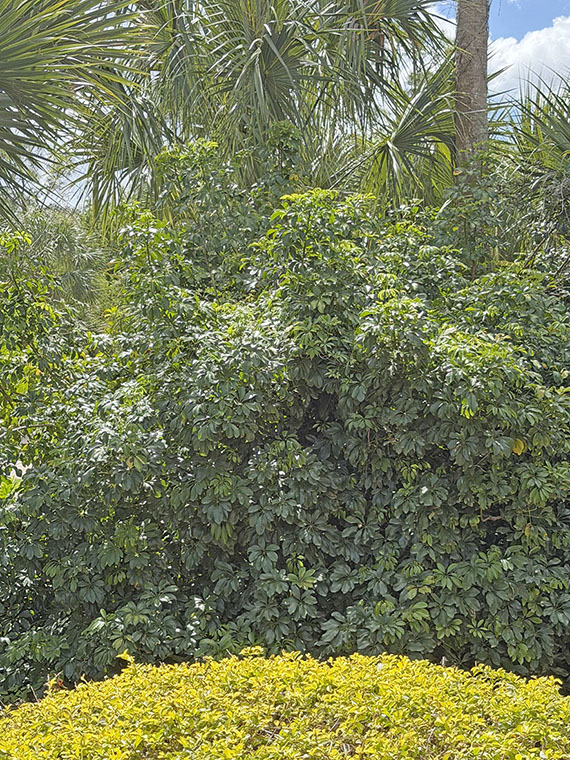
S. ARBORICOLA CAN BE USED AS A NATURAL LOOKING HEDGE.
When contemplating a plant genus to write about, I tour the gardens at Edison and Ford Winter Estates with open eyes, looking for that specimen that does one of two things – catches your breath or blends into the landscape, hardly noticed. To me, the Aralias are the latter. As a historical garden, I always attempt to find the significance of that specimen and tie it back to the Edisons’ or Fords’ botanical legacy.
Sometimes, this is easier said than done. In 2002, the City of Fort Myers prepared a Cultural Landscape Report (CLR), which took a deep dive into the plantings that were documented or otherwise known to exist during Edison’s time of ownership. Additionally, the report includes plants installed following the Edison years, that perhaps did not support an appropriate historical interpretation, and it concludes with recommendations for restoring the landscape accuracy as reasonably possible. At the same time, taxonomists around the world have been busy updating and reclassifying plant genera to reflect their access to new identification keys, including DNA testing. In other words, when we read about the plants discussed in the CLR, all is not always as it appears.
As early as 1908, it was documented that Thomas Edison procured the Geranium Aralia, also referred to as Wild Coffee (not related to any genus of coffee plants) from the Reasoner Bros. nursery for analysis of its latex content. Today, this plant goes by the binomial name of Polyscias guilfoylei where the genus name means “many shaded.” This is a great border type plant, native to Africa, South and Central America, and Asia. Known as a “humidity hound,” it thrives in Southwest Florida summers and will shed many of its leaves when there is an insufficient humidity level. A varietal named P. guilfoylei ‘Victoriae’ won the Royal Horticultural Society’s Award of Merit for its strong variegation and ease of growth. Sometimes referred to as the Victoria Tree, it grows to 24 feet.
In 1931, Dr. Walter Buswell once identified Aralias as one of the plants growing close to Seminole Lodge. They were listed as aralia, ornamental aralia and in some cases, frosted aralia. A renowned botanist of his day, Dr. Buswell, was hired by the Edisons to catalog their collection of tropical plants and at the same time he collaborated with the botanists involved with the Edison Botanic Research Corporation for rubber research. He was paid $25 a month for his work, and it seems that he was one of the first to suggest to Mina Edison that she consider creating a natural history museum in the garage from which he worked, which today is the ticket office and gift shop.
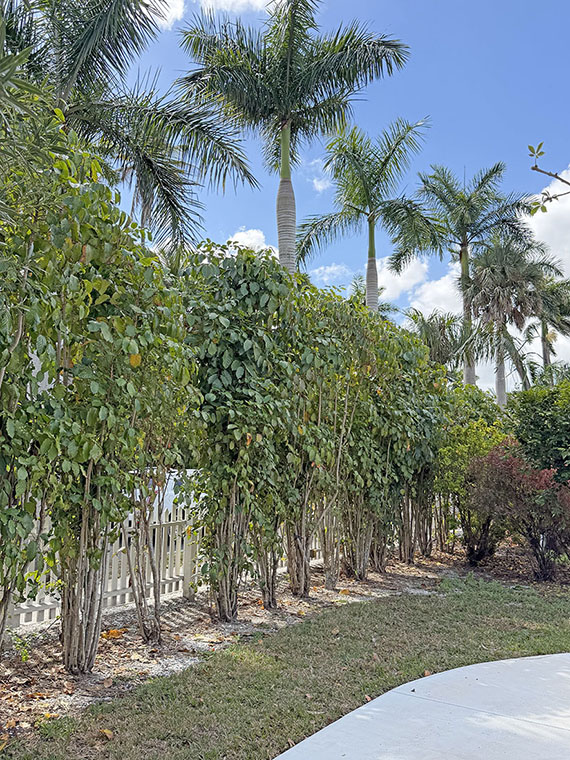
CENTRAL AMERICA. IT CAN BE USED AS A BORDER.
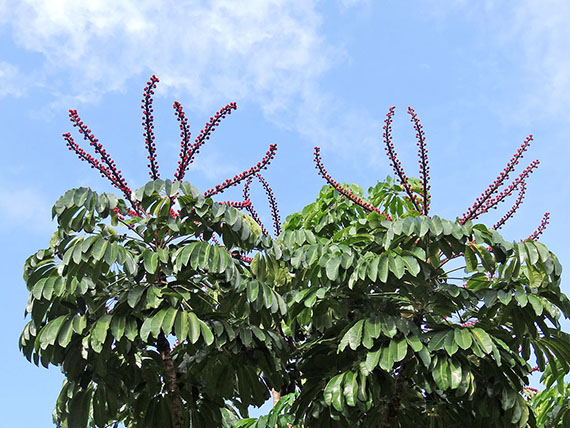
While the species is not mentioned, there is evidence that the Seminole Lodge aralias were Japanese or Queensland Umbrella Trees, Heptapleurum actinophylum. The Umbrella Tree is noted in a 1918 photograph capturing the wedding day of Charles Edison at Seminole Lodge. This would be consistent with the popularity of Japanese plants that captured the nursery industry in the 1920s. We still find them popping up in random spots in the gardens – especially in and around the bamboo stands, so it’s no wonder this plant ended up on the list of invasive species in Florida.
A later passage in the CLR describes the main gated entrance to the Edisons’ property as flanked by royal palms, a pair of silk oaks (Grevillia robusta), then a border of Aralia lutescans. Unable to identify this “aralia” in popular references, my search took me further, leading only to more questions. It would seem, that the referenced border shrubs were either the once popular Umbrella Tree, today known as the invasive Schefflera (Heptapleurum actinophylum) or perhaps it was the attractive, Arboricola or Dwarf Japanese Schefflera (Heptapleurum arboricola), which is more suggestive of a shrub border, growing only to 10 feet or so and a very popular landscape shrub to this day.
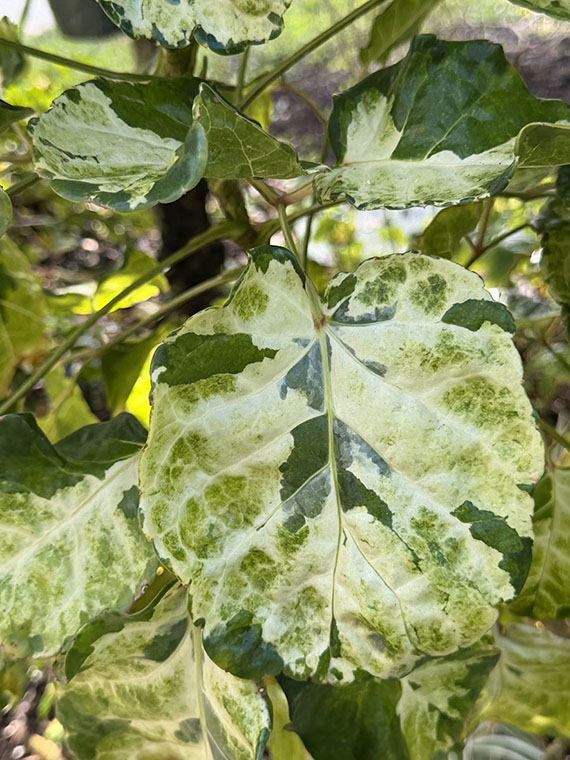
Prior to 2000, but no longer in place, an elongated shrub border grew just inside the McGregor picket fence on the Edison property, comprised of a dense row of Dinnerplate Aralias and maintained at a height of four feet, coupled with a dense row of crotons that have all since been removed.
HOME GARDENS.
A stroll along the McGregor fenceline of the Ford home today, one will find a mixed border of tall shrubs, including the Guilfoyle’s Aralia (the so-called wild coffee) recognized by its coarse toothed leaves. If you are looking for an easy, limited maintenance hedge, this may be the answer. Growing to 12 feet, these narrow shrubs are not fussy about their soil, taking kindly to some pruning, are happy in full sun to some shade and generally pest free. Their only request? Please do not let the roots sit in constantly wet soil.
Outside of the Moonlight Garden, one can find the P. scutellaria ‘Balfourii’ – a rounded leaf that is often variegated. There is also a white-edged variety known as P. balfourinana ‘marginata.’
IT IS LISTED AS AN INVASIVE SPECIES IN FLORIDA.
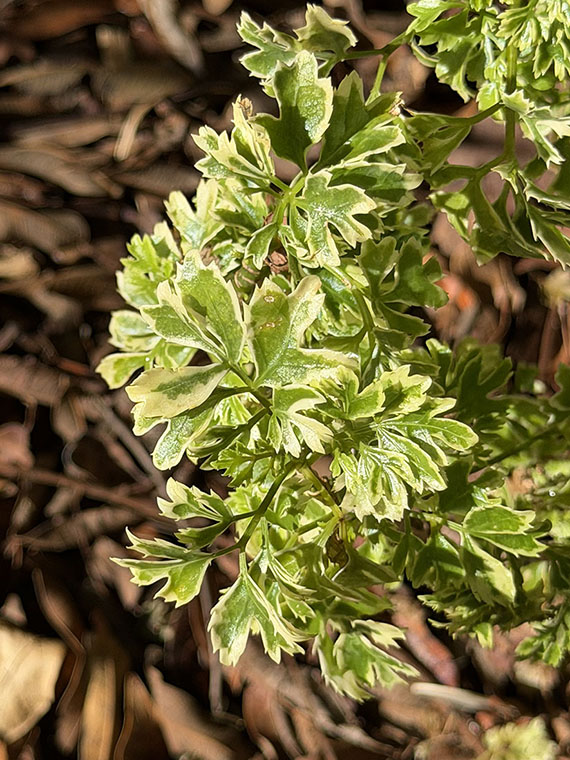
Another easy to grow species of the genus Polyscias, P. fruticosa, has gone in and out of popularity as often as short skirts. Native to Indonesia, the Ming Aralia is a fabulous houseplant or bonsai candidate due to its lovely, lacy, and compact foliage, and its slow growth requiring a repot only once every two or three years. Reportedly, the young leaves are edible and sport a spicy, parsley like flavor and are eaten raw in Southeast Asian cuisine or dipped in sauce. Sometimes called the Ming Tree, this “aralia” only grows 12 inches in a dozen years but can ultimately grow to 10 feet or more. As with other species of this genus, it is relatively pest free, loves humidity, its delicate leaves require bright (no direct) light, but will not tolerate wet feet or being overly watered. The plant may be mildly toxic to domestic pets. These plants do best with a regular monthly feeding of balanced fertilizer to maintain robust health.
To wrap it up, genus Aralia once included many other popular woodland species that thrive in the shady, moist gardens of Southwest Florida. The re-classification of many of these former “aralias” are now found in the genera Schefflera, Fatsia, Heptapleurum and Polyscias meaning none of the plants historically known as aralias in the Estates’ records, are now considered aralias at all.