


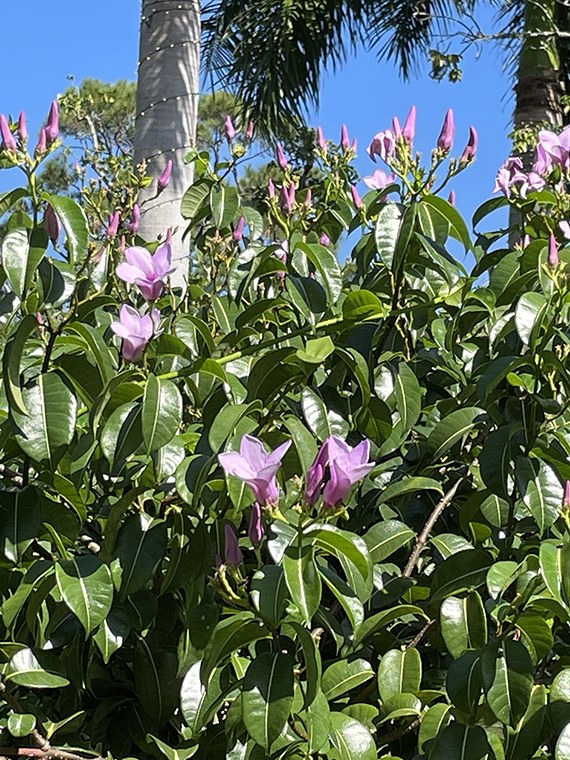
CRYPTOSTEGIA GROWING AT EDISON AND FORD WINTER ESTATES
Long before the word crypto entered our vernacular, Thomas Edison and Henry Ford experimented with growing crypto. But alas, money never did grow on trees; it was Cryptostegia, an aggressive vine commonly called Madagascar Rubber Vine that occupied a noteworthy place in their rubber research.
Many visitors to the Estates have seen this plant in the gardens but perhaps are not fully aware of its historical significance as one of the top four rubber research plants namely: Ficus, goldenrod, euphorbia, and Cryptostegia.
One hundred years ago, Thomas Edison obtained seeds of Cryptostegia madagascariensis from Chapman Field (so named after the first American soldier to perish in World War One), a U.S. Army base in Coral Gables where the USDA conducted subtropical plant research. While Henry Ford was planting the genus Cryptostegia grandiflora, a highly aggressive rubber vine on his property in Hendry County, Edison planted his Chapman Field seeds consuming approximately five acres at his Fort Myers property; the property side that today houses Edison’s laboratory. Edison was so sure that this was “the plant,” he employed all of his influence to obtain even more seeds of the C. madagascariensis variety, directly from Madagascar, where it once grew exclusively. Today, it is reportedly naturalized in Kenya, Tanzania, and Ethiopia.
Of the two species of Cryptostegia, the C. grandiflora planted by Ford on his 7000-acre holding in Labelle, Florida, is native to India, Mauritius and Madagascar and can easily grow to 100 feet, often surging 15-20 feet in a single month in years where seasonal rainfall is plentiful. It is considered a dangerous invasive in Australia, Africa, Asia, and the Americas.
The casual observer may find the visual appearances of the two species to be indistinguishable, but Edison’s C. madagascariensis produces flowers ranging from dark pink to almost purple; while the more aggressive species of C. grandiflora (is not grown at the Estates) produces flower colors that span white to rose and its pods are easily double the length of the “Edison” Cryptostegia. The summer rains encourage germination of the previous year’s seeds, and the fastest growth occurs in autumn, producing flowers that are triggered by the drier months that follow the traditional rainy season.
Southwest Florida weather suits the Cryptostegia so well that it is considered potentially invasive and its planting and growth should be carefully monitored here in South Florida, and up through Central Florida. The genus thrives in warm and humid climates and accepts annual rainfalls from a low 20” to a high 60” per year (we average 54” per year). Not fussy about soils, they do require a sturdy structure upon which to climb, be it a trellis or a tree. The many seeds produced (always a good clue about the potential invasiveness of a plant), are carried on winds or by flooding waters.
By its very nature that C. madagascariensis grows naturally in wetter areas, it is presumed this is why Edison desired the species, in addition to the fact that hybridizing the two species, produced plants with a higher latex content, leading some botanists to theorize that the C. madagascarienses genetically was a superior latex producer while available in a more compact and manageable sized plant. The fast growth characteristics of the C. grandiflora in the hybrid, held promise of two harvestable crops per season for Edison.
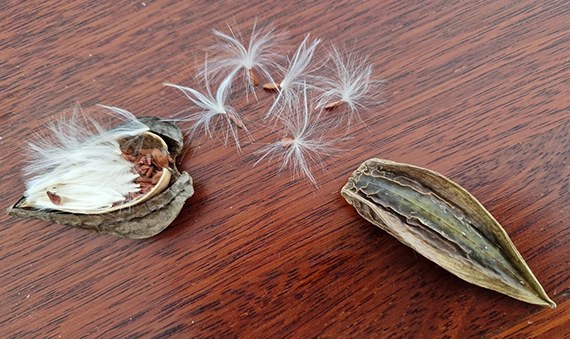
The plant produces large pods borne in pairs along the stems. Like milkweed, the seeds are brown and flat, carried by a tuft of silky white fibers, providing several different opportunities for seed dispersal. This is no coincidence, as both the Asclepias genus of plants (milkweeds) and Cryptostegias belong to the dogbane, or Apocynaceae Family (loosely translated to “dog-away” from ancient Greek).
Edison, Ford and Firestone were extremely motivated to grow the latex rich vine with the potential for two harvests per year and Edison believed so much in the plant’s future as the answer to the United States’ domestic rubber source, that he communicated with his ground contacts in Madagascar via secret code in efforts to obtain more seed.
The most aggressive planting of rubber candidates at the Estates was in 1927, with ficus, tapioca, poinsettias, milkweed, hemp, bananas and the Cryptostegia. Soon, Edison was convinced that the ultimate source of domestic rubber was going to be extracted from an “herb-like” plant, from its leaves—not from the stems and roots that produced the latex of the former plants. Early on, Edison recognized the efficiency of using machinery and his attempts to adapt the concept to rubber extraction led him to conclude that the above plants, with their latex-rich stems, were not conducive to machine extraction.
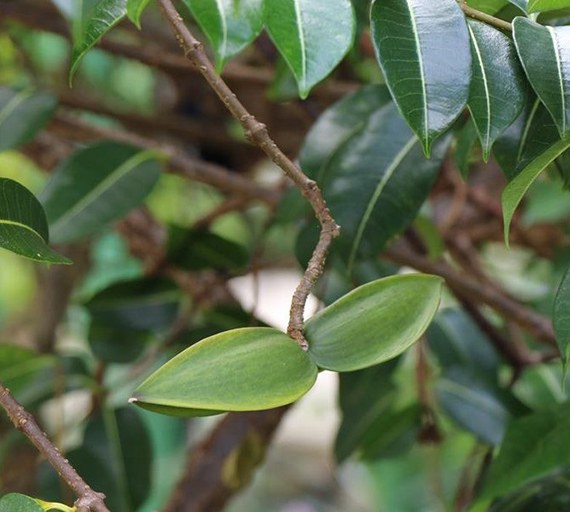
Historically, the Cryptostegia played a role in village medicine in its indigenous areas but only under the watchful care of practitioners. Today, it is well known that the latex, in fact all parts of this plant, are toxic to humans and livestock – particularly elephants and other grazers in Africa, which find the taste quite distasteful but are forced to consume the plant during times of extreme drought when green grass is not available. As a severely invasive species in Australia, it grows over savannahs and climbs over native trees, essentially cutting out the sunlight. So remote are the invaded forests, there are no practical means available of controlling or eradicating its growth at this time. Like all dogbane family members, assume this plant is toxic to your fur babies.
While it is not this writer’s intent to encourage gardeners to grow this plant in their landscape, it is important to the legacy of Thomas Edison and Henry Ford to understand how the men worked together toward achieving a common goal and one of the botanical routes they explored.