

Nearly a thousand miles east of the coast of Madagascar, in the Indian Ocean, sits an archipelago of islands collectively known as the Mascarene Islands. Their isolated nature and lack of humans until about 1507, allowed these volcanic islands to enjoy a vast biodiversity of flora and fauna.
Since either the arrival of the Arabs in late 900s or the Europeans in 1507, these islands have rotated through a series of sovereign flags from Portugal, France, Britain and the Dutch. Upon exposure to European exploitation, the once naturally endowed islands of Reunion, Rodrigues and Mauritius today are densely populated and virtually stripped of natural vegetation. It is reported that there is no natural vegetation remaining on Rodrigues, about 5% on Mauritius and 40% on Reunion.
The diverse flora and fauna were attributed to the wide variety of habitats found on the islands – everything from coastal wetlands, swamp forests, and dry lowlands to mountain cloud forests. Today, the natural vegetation has been largely replaced by humans, sugarcane, tea and conifer plantations. One of the world’s most active volcanos, Piton de La Fournaise is a tourist attraction on Reunion, formerly known as Ile Bourbon – yes, where the fragrant Bourbon roses originated.
As a semitropical botanical garden, how fortunate are we, that Edison and Ford Winter Estates can offer our visitors an opportunity to view and appreciate so many of the species once endemic to these remote islands: Dombeya, Pandanus or Screw Pine, species of Cyathea or tree ferns, and a number of palms including the Hyphorbe genus, Dictyosperma genus and one of my favorites, the Latania (La-TAN-ee-a) genus.
Due to poaching and other human activities, the Latania species that naturally grew on seaside cliffs and savannahs are virtually extinct in the Mascarenes. The Latania genus has three species, each a solitaire palm, commonly known as the Blue, Red and Yellow Latan palms. At the Estates, we have the Blue and Yellow Latans in our collection, having lost our Red Latan to palm weevils.
The genus is well adapted to our climate as Latans prosper during warm and wet summers followed by dry winters. In their native environment, they would receive approximately the same annual rainfall – between 50 and 60 inches – as we enjoy in Lee County. Latanias are all fan palms, without a crown shaft and their size makes them a terrific residential landscape palm – each offering a slightly different appearance.
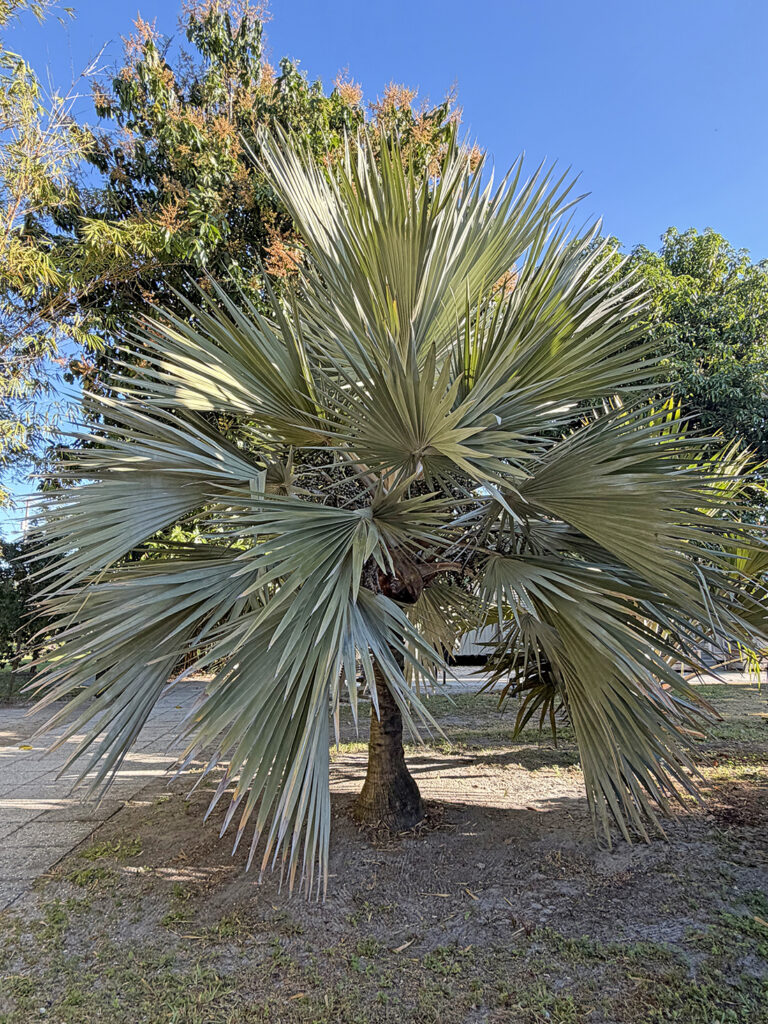
Ideal for a silver or blue garden theme, the glaucous Blue Latan (Latania loddigesii) palm once endemic to Mauritius is often mistaken for Bismark (Bismarckia nobilis) palms due their solitary construction with enormous stiff blue-green fronds. These slow growing palms are somewhat salt tolerant and very drought tolerant, and any of the Latanias will grow in most soils, as long as they are provided excellent drainage. They appear to thrive in calcareous soils – so perhaps a good palm choice for Cape Coral, where limestone soils are prevalent. A healthy canopy on a Blue Latan has about 15 fronds, whereas a Bismark canopy includes about 30 fronds. Blue Latans mature at 35 feet making them a more suitable alternative to a compact landscape than the towering Bismarks and can make quite the statement when planted in multiples. While both are considered self-cleaning they are slow to drop their spent fronds and may need an occasional trim.
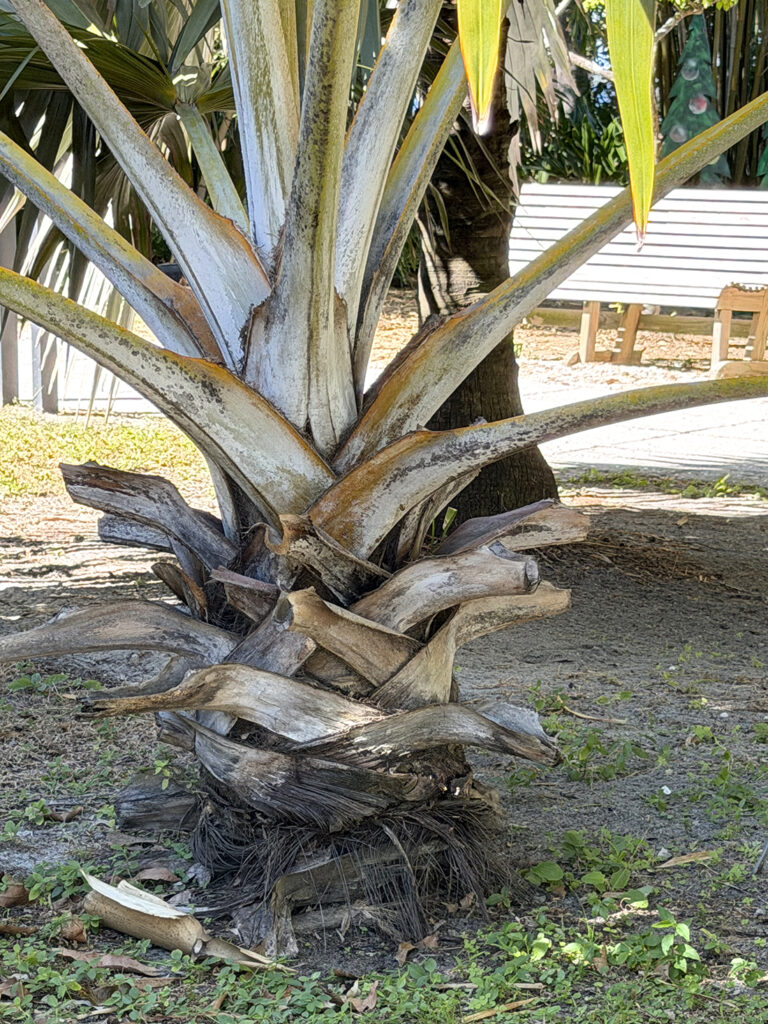
The Blue Latan has a heavy white waxy tomentum – a velvety mat – on the undersides of its fronds that doesn’t diminish with age. Being slightly less cold hardy than the Bismarks, they still thrive in our Zone 10. Another identification tip is that the Blue Latans do not have fibers as seen on the Bismark fronds.
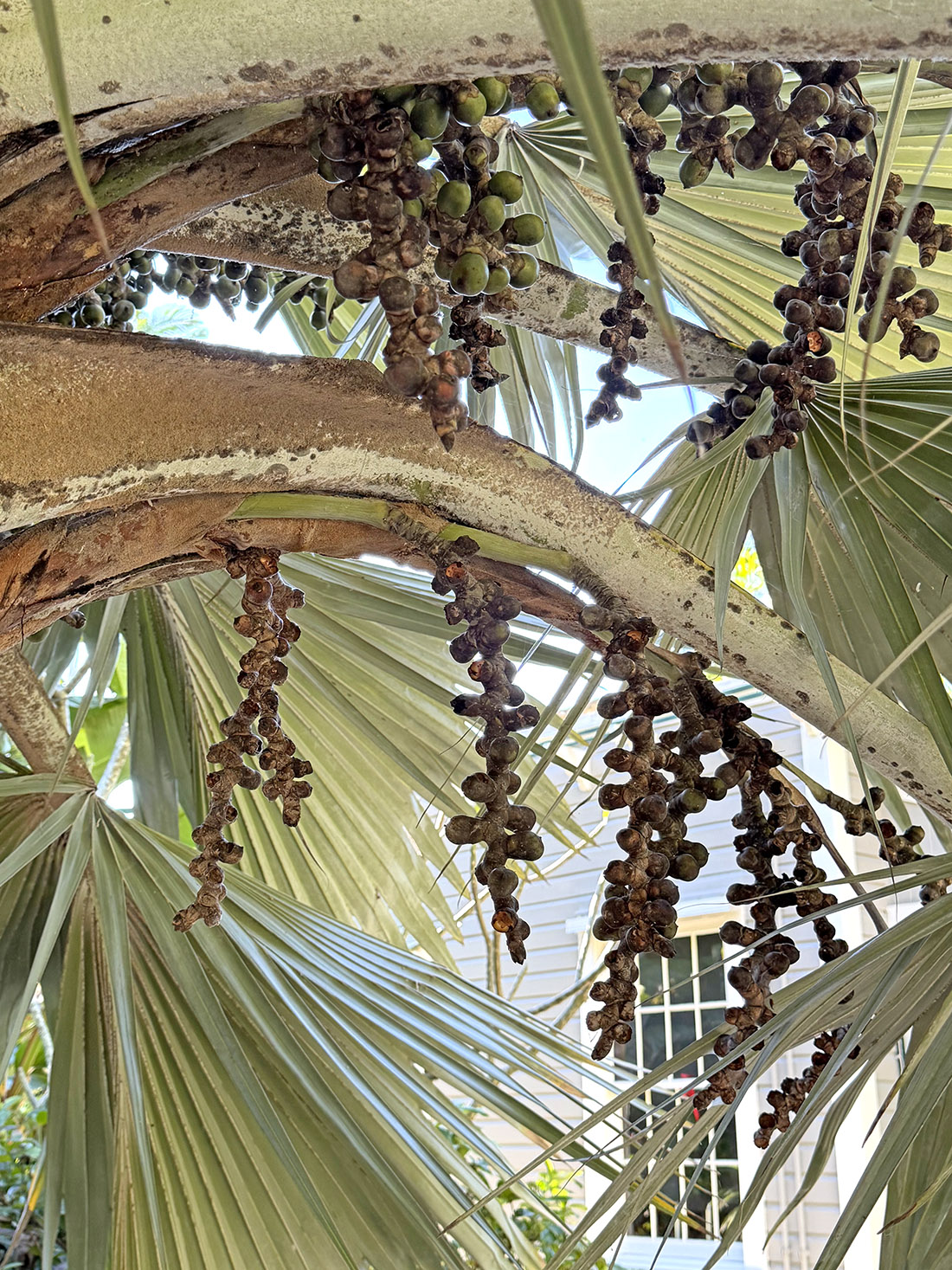
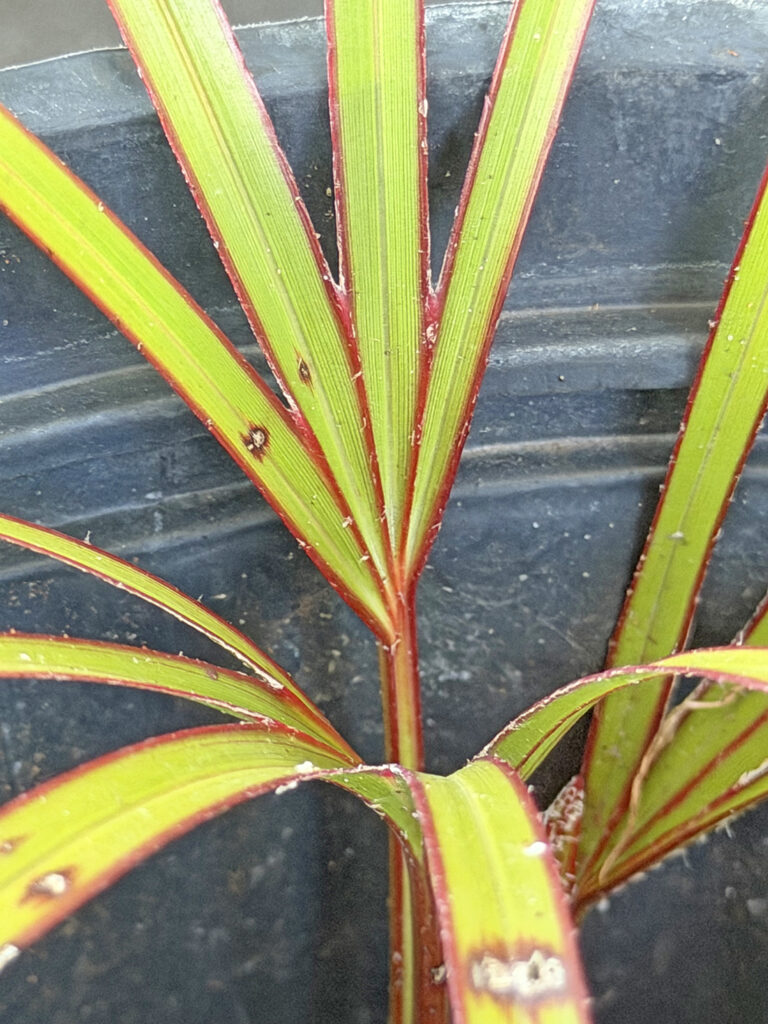
Each of the three Latania species is dioecious, meaning each palm is either male or female though, within the genus, species readily cross-pollinate, as evidenced by recent seedlings I discovered growing naturally on the property. Seedlings of the Blue Latan also have red margins and may be mistaken for the Red Latan (Latania lontaroides).
When any of the Latanias are fully grown, they are nearly indistinguishable from each other, though as seedlings, their common name colors are obvious. When young, Red Latans are never mistaken for the Blue Latan, with bright red petioles or leaf stalks. Seed identification is the only certain means of identification between the species – Red Latan seeds are not as highly sculpted as those of their blue cousin. In fully grown Latania palms, the pointed hastula at the base of the frond, where the fan connects to the stem, on Red Latans is raised while the Blue Latan hastula lies flat in the front. Native to the Island of Reunion, with very few surviving in the wild, the Red Latan is sure to go the way of the Dodo Bird on Reunion, unless we, as “bankers” of nature’s future are able to secure its responsible propagation. The hastula of the Bismark Palm is decidedly uneven when compared to the Blue Latan.
Requiring active conservation, the Latania verschaffeltii or Yellow Latan with origins on Rodrigues has only about 50 naturally occurring specimens remaining. It is clearly recognized with its bright yellow petioles covered in white tomentum which lasts through adulthood. Fronds are thinner, and never as stiff as the Blue Latan with a distinct yellowish or orange hue, and the Yellow Latan hastula is flat and blunt. For palm enthusiasts, it is fun to learn the keys to identification. If you want to learn more about palms, there will be a class at the Estates called “Palm Reading” on March 24.
To preserve and hopefully propagate and share endangered and rare species is something that we, as horticulturists, live for. We hope to see you in the garden soon!