



PANDANUS: FROM WORLD’S OLDEST PLANT FOSSIL TO YOUR KITCHEN
One of the largest plants growing at the Edison and Ford Winter Estates greets visitors along the main allée, just outside the Edisons’ home. Heavily damaged by Hurricane Ian, this unusual plant has made a full recovery, testament to its resilience to wind, water, and salt. This Pandanus looks somewhat like a palm on the top and a mangrove underneath the heavy canopy of drooping leaves.
Henry Nehrling, one-time advisor to Thomas Edison, noted in a letter written in 1929 that “the east side of the house was shaded by large overhanging rubber trees and masses of screw pines…” Even Mina Edison listed the Pandanus as a plant of interest for the garden tours that she offered in the 1930s.
Commonly known as screw pine, Pandanus species have grown on the property since at least 1910, likely purchased from the Reasoner Brothers Nursery of Sarasota in 1907 and it grew in the area that now hosts the Latania palms, near the Caretaker’s Cottage. It is noted in historical writings that the screw pine once grew along the west side of the Edison’s pool as well. Prior to the hurricanes, the large Pandanus had been carefully pruned and trimmed to show off its stilt roots, which give the plant stability in sandy or marshy environments and support the top-heavy trunks. It has been allowed to simply grow and recover and soon will be ready for another beauty pruning.
The Pandanus genus claims one of the Earth’s oldest fossilized plants, discovered in Queensland, Australia—the species Pandanus estellae, dated to approximately 30 million years ago and is part of the evidence to support the ancient supercontinent theory known as Gondwana, which included South Asia, Africa, Antarctica, Australia, and India.
Consequently, we know that Pandanus is a tropical species native to Australia, the Malay Peninsula, Southeast Asia and across the tropical Pacific regions to include Hawaii. During the savage tsunami of 2006, Pandanus odoratissimus that grew in coastal regions saved many villages. Subsequent studies determined that the combination of the complexly rooted P. odoratissimus and Australian Pine Tree (Casuarina equisetifolia) provides an effective “green belt,” reducing the surge and energy of such deadly tsunamis in the Pacific regions.
The ecosystem offered by coastal Pandanus is matched by the genus’ versatility to provide materials for locally made rope, mats, baskets, roof thatch and as a healthy food source from some species. Estimates vary on the number of species in the genus – anywhere from 500 to 700, depending on the source document.
As a tropical plant, a few species can be successfully grown in Florida, though after the recent damaging cold spell, choose wisely. Pandanus baptisstii is a smooth-edged leaf variety that does not produce any fruit – avoiding the potential for a messy yard. P. veitchii is another non-fruiting variety for Florida growers, producing a 40-foot-tall plant with white stripes along the spiny leaf edges.
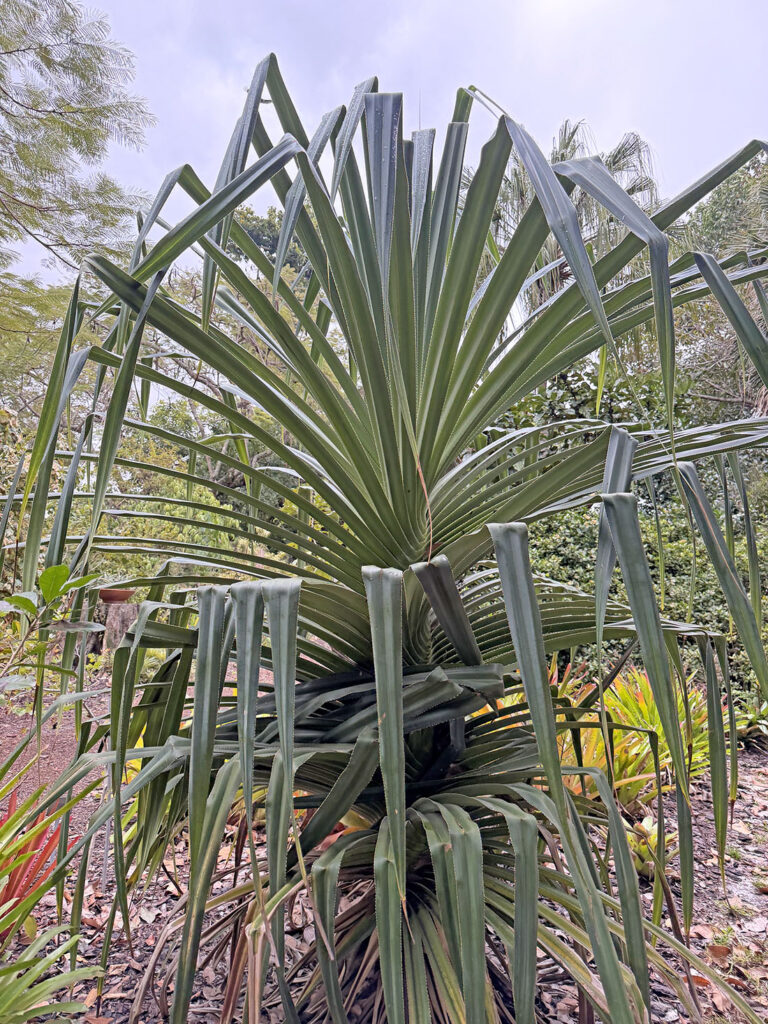
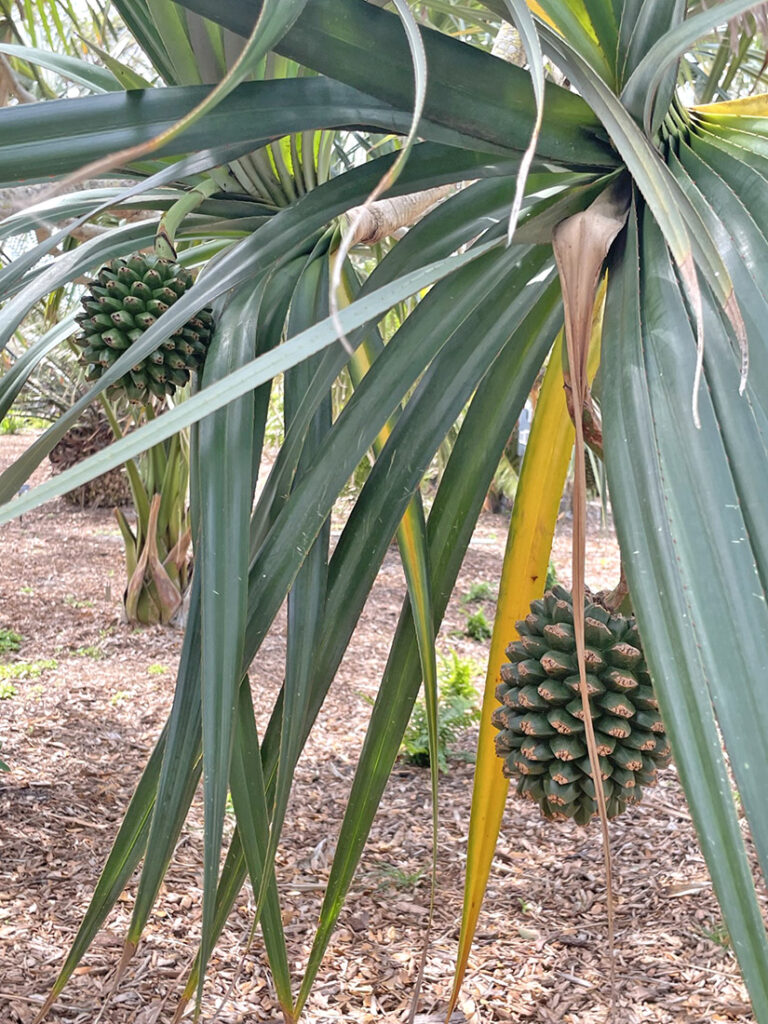
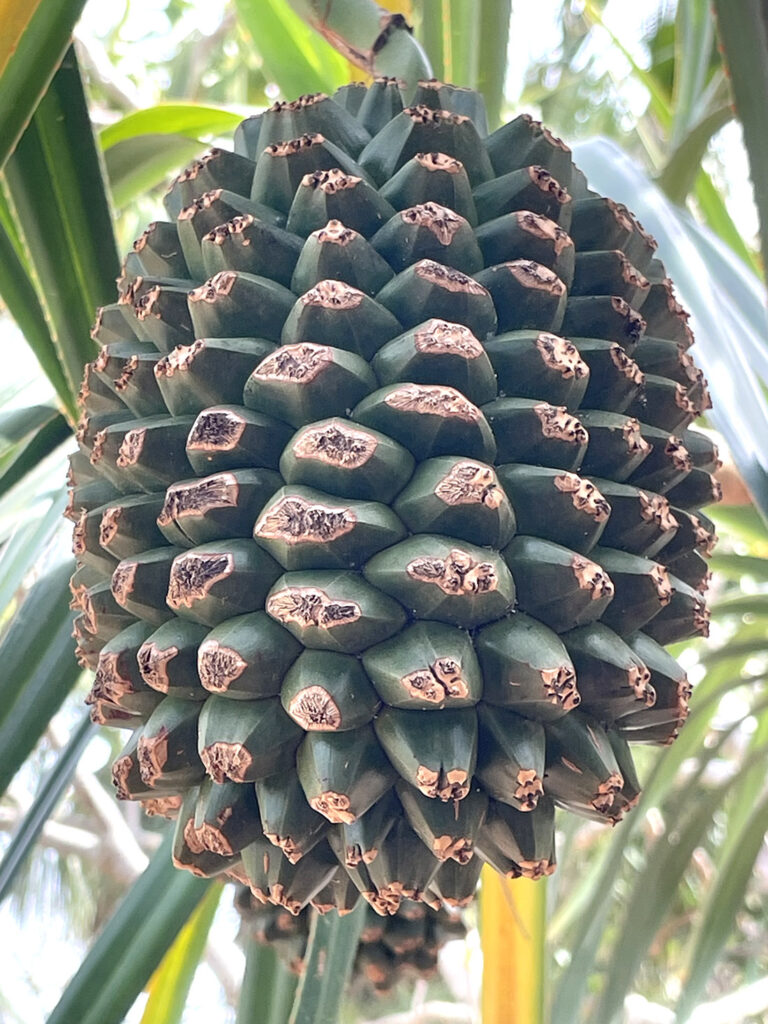
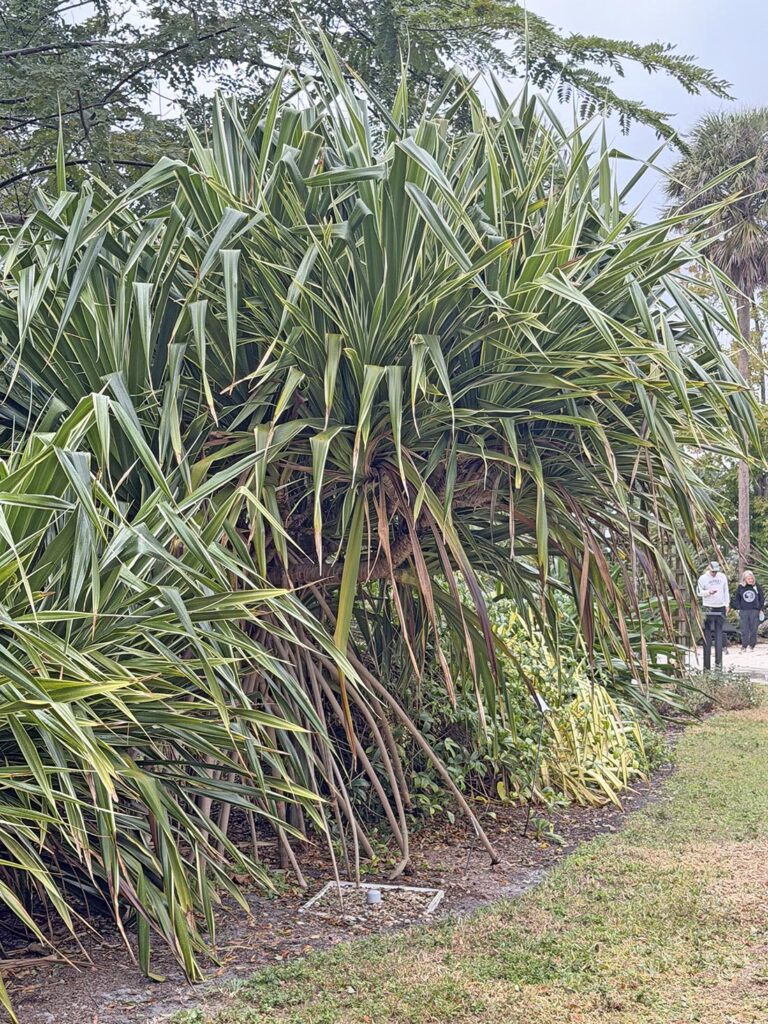
SPECIES CURRENTLY GROWING AT THE ESTATES INCLUDE PANDANUS UTILIS – A NATIVE TO MADAGASCAR AND PANDANUS MONOTHECA – THE GREAT SCREW PINE – AN UNBRANCHING PANDANUS THAT IS ENDANGERED IN ITS NATIVE THAILAND, AND PANDANUS DUBIUS OR KNOB FRUITED SCREW PINE. ALL ARE FOUND IN THE SOUTH RESEARCH GARDEN AT THE ESTATES.
Most species of Pandanus do not grow quickly but almost all of them are dioecious – producing fragrant flowers on the male plant and fruit only on the female plant. Because the male plants flower annually and the female only every other year, it is possible they don’t bloom at the same time to bring about the fruit.
The unusual fruit is of great interest, looking something like a huge pinecone, hence its common name (the screw referring to the whorled or circular growth pattern of its leaves around the trunk) or even a trimmed pineapple. In many species, but not all, the fruit is edible, though only when it turns bright orange or red. When the fruit bursts open, it produces several seeds called “keys.” These can be planted but allow up to a full year for the key to sprout. Pandanus sp. mature at eight to 10 years old and will reliably produce fruit for 50 years or more, making it an important source of nutrition in some cultures (the fruits are mashed to create a “butter” for cooking and flavoring).
Species currently growing at the Estates include Pandanus utilis – a native to Madagascar and Pandanus monotheca – the Great Screw Pine – an unbranching pandanus that is endangered in its native Thailand, and Pandanus dubius or Knob Fruited Screw Pine. All are found in the South Research Garden at the Estates.
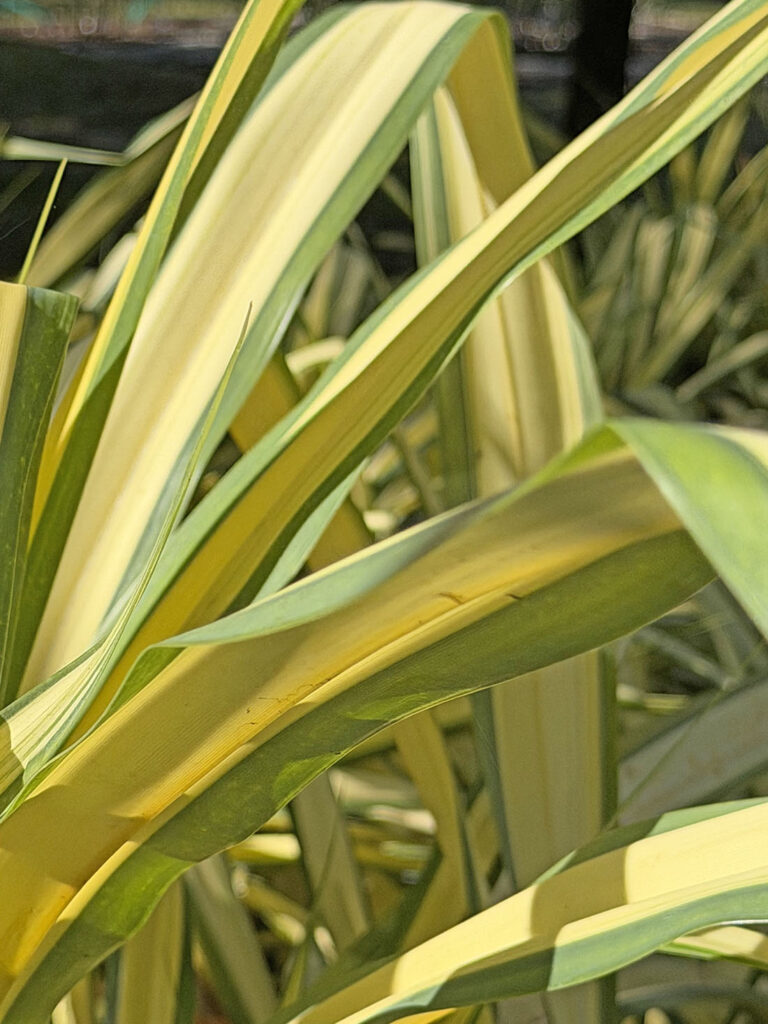
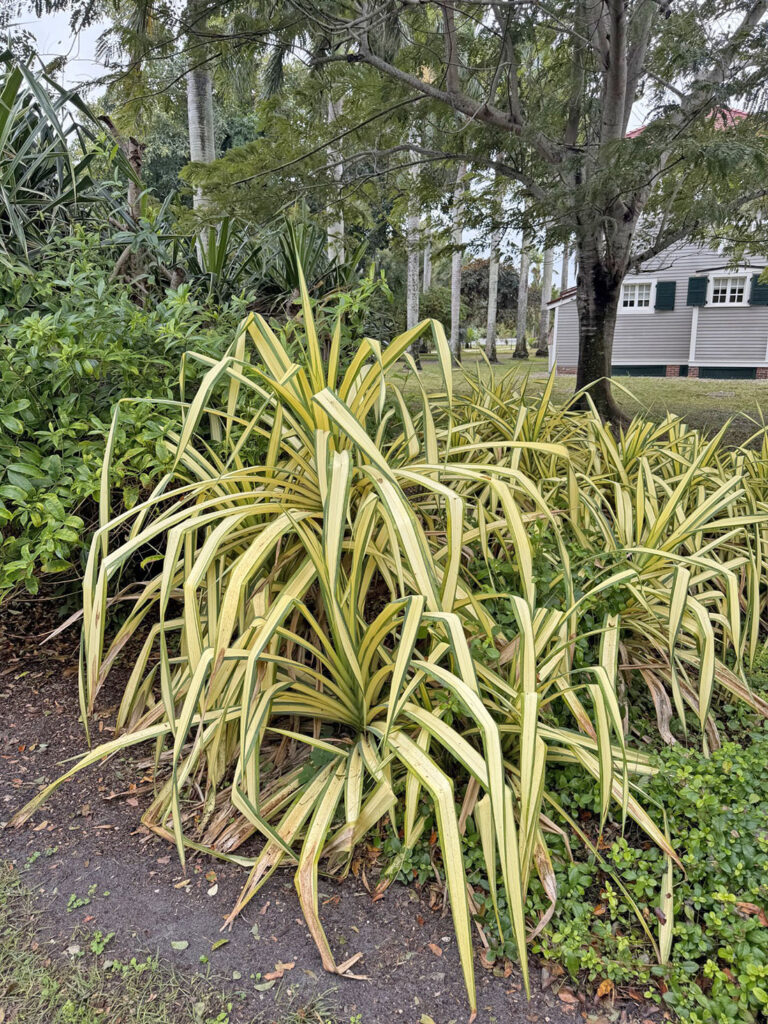
ON PANDANUS BAPTISII VARIEGATA, THE LEAVES ARE VARIEGATED AND APPEAR STRIPED
Not every garden is ready for the high moisture requirement of Pandanus nor scaled to accommodate its mature size; however, everyone in South Florida can grow a pot of Pandanus amaryllifolius or Fragrant Pandan. Of unknown origins, this small shrub-like Pandanus offers many reputed health benefits and culinary inspiration.
Indian cuisine employs the juice of boiled Pandan to flavor curries, jellies and desserts. It may also be used as an organic food wrap, but the leaves are rarely eaten. Regularly harvesting the leaves will cause the plant to continue to produce the juvenile leaves, which are preferred. The flavored water imparts a coconut/almond flavor to rice and other recipes. This evergreen, clumping herb is best grown in a rich, well-draining soil. A complete fertilizer applied three times a year is all it should need in addition to keeping the plant moist but not waterlogged. When temperatures dip below 50 degrees, bring the potted pandanus indoors.
A leaf, rubbed on skin can be used as a natural insect repellant, especially against mosquitoes or soak the leaves in water and put in a spray bottle to apply wherever needed. Fragrant pandans is not a small herb, so give it a good-sized pot, at least 12 inches wide, where it can grow and produce pups or offshoots for you to share with friends. Let the offshoots grow to about five inches tall before removing them from the mother plant. None of the Pandanus genus is toxic to domestic pets.
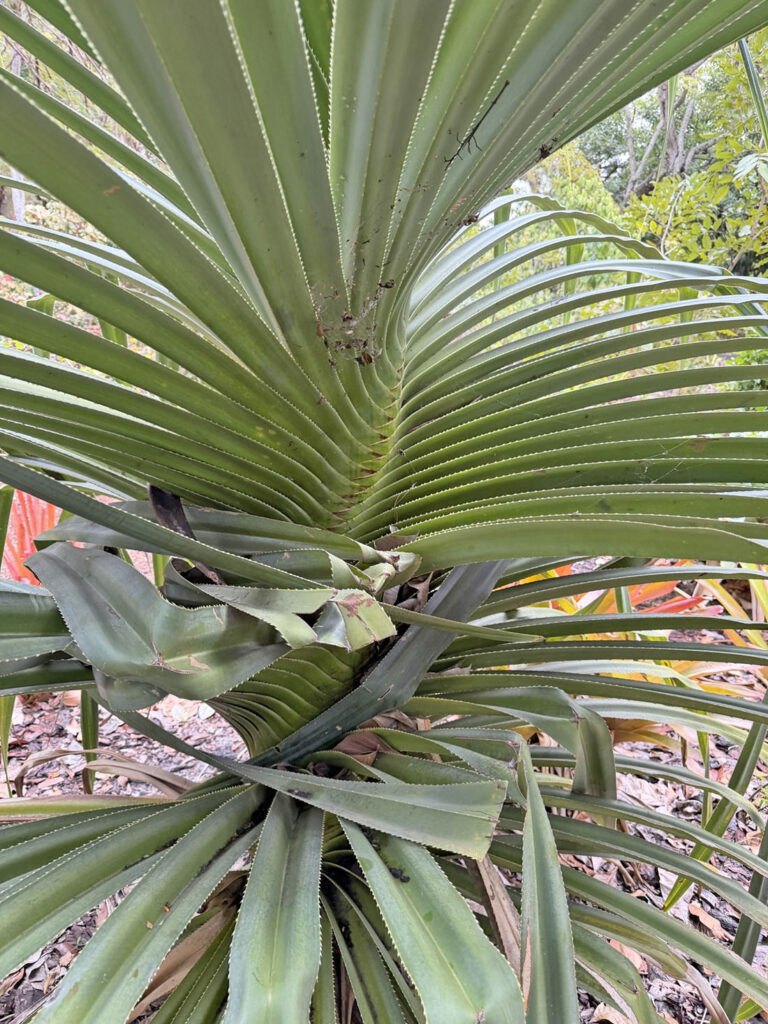
To see Pandanus, take a Garden Tour of the Estates and ask the tour guide to identify the plants. Garden Tours are offered at 10 a.m. on the second Wednesday of each month. On the tour, horticulturists take visitors around the more than 20 acres of botanical gardens and go behind the scenes and highlight the propagating nursery, crop gardens, and heritage and edible plants. Registration is required at EdisonFord.org.