
VANILLA DILLONIANA IS CURRENTLY BLOOMING AT EDISON AND FORD WINTER ESTATES.
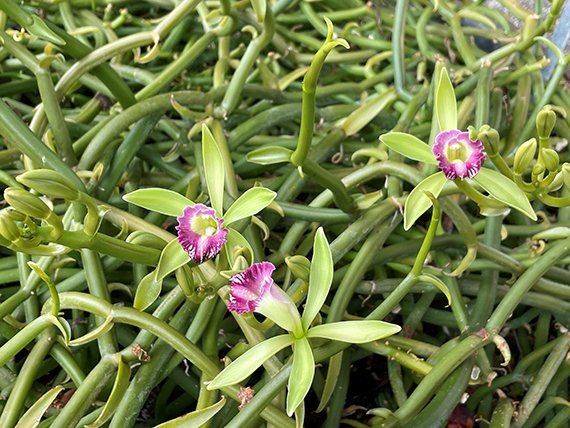
Now appearing on Orchid Lane at Edison and Ford Winter Estates, Vanilla dilloniana is making its debut. This is no ordinary orchid – if there even is such a thing? Sometimes called Dillon’s Vanilla or Mrs. Lott’s Orchid, this extraordinary example of a leafless vanilla is native to an old growth area of Miami known as Brickell Hammock, which ran from the Miami River to Coconut Grove and is part of an extensive geologic area known as the Miami Rock Ridge. Prior to conceding to modern development, the area was a high hammock forest, considered one of the most diverse tropical forests in all of Florida. Fresh water from the Everglades mixed with the rich estuarine waters of Biscayne Bay but today, only eight acres of the original hammock remain. One can visit Simpson Park Hammock, which claims to host 96 native species, including 15 that are endangered.
Years and years ago, Robert Reifer was one of several horticulturists who acquired a cutting from the original plant owned by Dr. and Mrs. Young Cleveland (Mary) Lott, who legend says, was gifted the vanilla in 1928 by collector Frank Erwin. The V. dilloniana reportedly grew so large, it filled a corner of the Lott’s yard, where botanical artist Gordon Dillon came to capture it on paper. He alone is responsible for providing the original illustrations for most of the Florida native orchids.
Mr. Dillon would become the primary orchid illustrator for the Ames Herbarium (at Harvard University) where the fledgling American Orchid Society was also housed. In 1946, the orchid was given its name and accepted by KEW of the Royal Horticulture Society: Vanilla dilloniana. While there are many plants in private collections today, it is doubtful that any other surpasses the behemoth specimen grown by Mr. Reifer. Exercising author privilege, we’ll refer to this massive orchid as Reifer’s dilloniana while it is in residence at Edison and Ford Winter Estates. Most of the photographs on the internet of the Vanilla dilloniana, are in fact, of this very specimen, and all photos used herein, are with his permission.
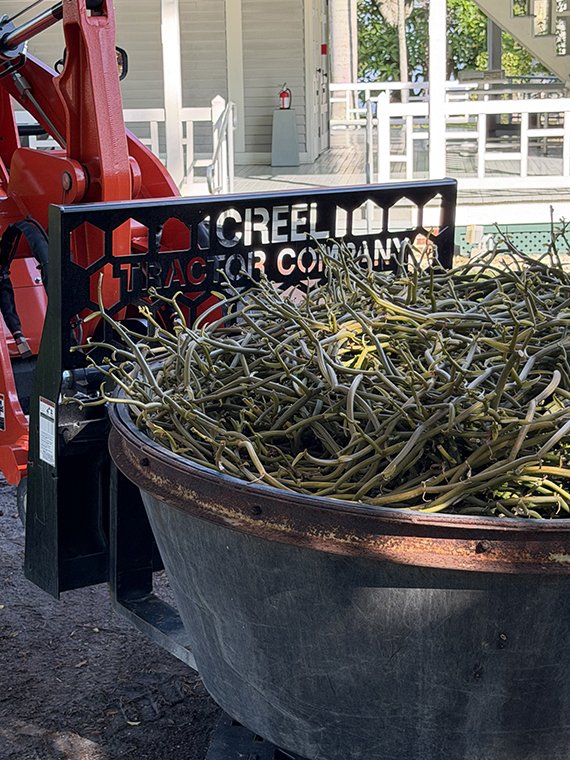
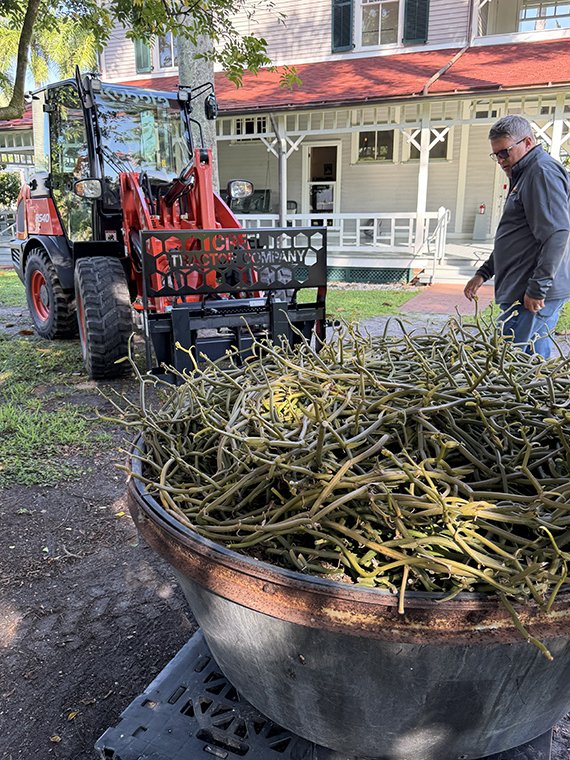
One of only five native Florida vanilla species, V. dilloniana is considered leafless, as its leaves are barely distinguishable on the succulent vine. Reportedly, it is found in Puerto Rico, Cuba, Haiti and in moist, tropical scrub forests within the Caribbean. Unlike other vanillas, this species does not prosper if they are grown on a trellis, preferring to thrive in a loose soil, where the tiny roots found at the segments may reach the growing medium. Its flowers differ from the other so-called leafless Florida vanilla, V. barbellata, in that the former’s sepals are more elongated, its flower does not have a white margin, and the lower flower petal is elongated. While no longer as common in South Florida, the existence of Vanilla barbellata is considered stable in the outer regions of its native range.
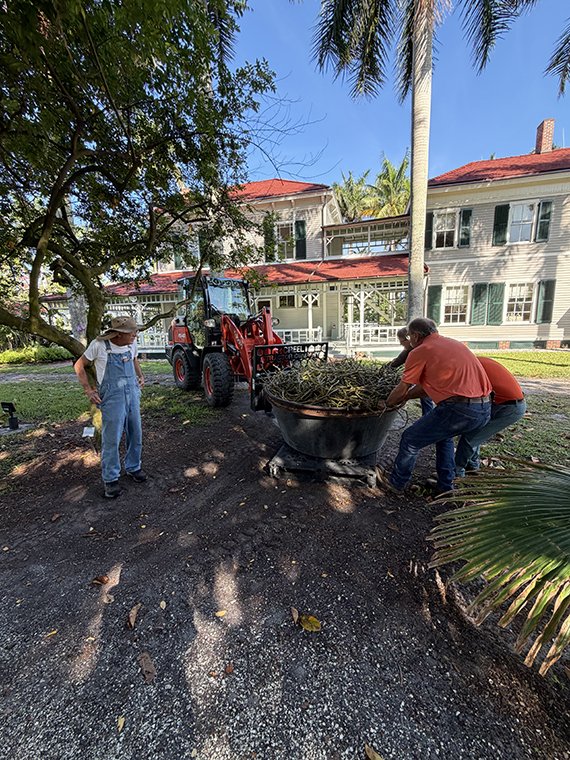
On behalf of Mr. Robert Reifer, I was able to “orchi-strate” the relocation of Reifer’s dilloniana to Mina Edison’s beloved Orchid Lane, just behind the Edison’s winter home. This initiative would not have been possible without the generous assistance and coordination of Mr. Todd Shreffler and Mr. Brian Creel of Creel Tractor of Fort Myers who provided their equipment and time to make this three-year plan a reality. Under the watchful eye of Mr. Reifer, Creel professionals loaded the orchid and its 125-gallon pot into a covered vehicle and just as carefully unloaded it and secured it to the rubber pallet on Orchid Lane…maneuvering the plant into the precise heliotropic orientation recommended by Mr. Reifer.
The orchid will be monitored and the number of flowers produced by Reifer’s dilloniana will be recorded. Each fragrant bloom will open at night and last for a single day but will continue successively in July. Don’t miss the opportunity to view this AOS-award-winning specimen!